The Minor Gesture. (2013) Erin Manning. Series: Thought in the Act https://www.jstor.org/stable/j.ctv111jhg1
This book begins in a minor key and works to create a field of resonance for the minor. It does so through the concept of the minor gesture. The minor gesture, allied to Gilles Deleuze and Félix Guattari’s concept of the minor, is the gestural force that opens experience to its potential variation. It does this from within experience itself, activating a shift in tone, a difference in quality (Manning, 2013:1).
Cite as: Manning, E. (2013). The Minor Gesture. Duke University Press. https://doi.org/10.2307/j.ctv111jhg1
The Minor Gesture Introduction PDF: https://api.pageplace.de/preview/DT0400.9780822374411_A35629198/preview-9780822374411_A35629198.pdf
+
Approaches to What?
Georges Perec
(Perec, G. (1973) Species of Spaces and Other Pieces. Penguin, pp. 205-7)
“What speaks to us, seemingly, is always the big event, the untoward, the extra-ordinary: the front-page splash, the banner headlines. Railway trains only begin to exist when they are derailed, and the more passengers that are killed, the more the trains exist. Aeroplanes achieve existence only when they are hijacked. The one and only destiny of motor-cars is to drive into plane trees. Fifty-two weekends a year, fifty-two casualty lists: so many dead and all the better for the news media if the figures keep going up! Behind the event there is a scandal, a fissure, a danger, as if life reveals itself only by way of the spectacular, as if what speaks, what is significant, is always abnormal: natural cataclysms or social upheavals, social unrest, political scandals.

In our haste to measure the historic, significant and revelatory, let’s not leave aside the essential: the truly intolerable, the truly inadmissible. What is scandalous isn’t the pit explosion, it’s working in coalmines. ‘Social problems’ aren’t ‘a matter of concern’ when there’s a strike, they are intolerable twenty-four hours out of twenty-four, three hundred and sixty-five days a year.
Tidal waves, volcanic eruptions, tower blocks that collapse, forest fires, tunnels that cave in, the Drugstore de Champs-Elysées burns down. Awful! Terrible! Monstrous! Scandalous! But where’s the scandal? The true scandal? Has the newspaper told us everything except: not to worry, as you can see life exists, with its ups and downs, things happen, as you can see.
The daily newspapers talk of everything except the daily. The papers annoy me, they teach me nothing. What they recount doesn’t concern me, doesn’t ask me questions and doesn’t answer the questions I ask or would like to ask. What’s really going on, what we’re experiencing, the rest, all the rest, where is it? How should we take account of, question, describe what happens every day and recurs everyday: the banal, the quotidian, the obvious, the common, the ordinary, the infra-ordinary, the background noise, the habitual?
To question the habitual. But that’s just it, we’re habituated to it. We don’t question it, it doesn’t question us, it doesn’t seem to pose a problem, we live it without thinking, as if it carried within it neither question nor answers, as if it weren’t the bearer of any information. This is not longer even conditioning, it’s anaesthesia. We sleep through our lives in a dreamless sleep. But where is our life? Where is our body? Where is our space?
How are we to speak of these ‘common things’, how to track them down rather, how to flush them out, wrest them from the dross in which they remain mired, how to give them a meaning, a tongue, to let them, finally, speak of what is, of what we are. What’s needed perhaps is finally to found our own anthropology, one that will speak about us, will look in ourselves for what for so long we’ve been pillaging from others. Not the exotic anymore, but the endotic.
To question what seems so much a matter of course that we’ve forgotten its origins. To rediscover something of the astonishment that Jules Verne or his readers may have felt faced with an apparatus capable of reproducing and transporting sounds. For the astonishment existed, along with thousands of others, and it’s they which have moulded us.
What we need to question is bricks, concrete, glass, our table manners, our utensils, our tools, the way we spend our time, our rhythms. To question that which seems to have ceased forever to astonish us. We live, true, we breathe, true; we walk, we open doors, we go down staircases, we sit at a table in order to eat, we lie down on a bed in order to sleep. How? Why? Where? When? Why?
Describe your street. Describe another street. Compare.
Make an inventory of you pockets, of your bag.
Ask yourself about the provenance, the use, what will become of each of the objects you take out.
Question your tea spoons.
What is there under your wallpaper?
How many movements does it take to dial a phone number?
Why don’t you find cigarettes in grocery stores? Why not?
It matters little to me that these questions should be fragmentary, barely indicative of a method, at most of a project. It matters a lot to me that they should seem trivial and futile: that’s exactly what makes them just as essential, if not more so, as all the other questions by which we’ve tried in vain to lay hold on our truth.”
+
Ten Propositions for Research-Creation. (2016) Erin Manning, with images by Joanne ‘Bob’ Whalley.
Research-creation generates new forms of experience; it situates what often seem like disparate practices, giving them a conduit for collective expression; it hesitantly acknowledges that normative modes of inquiry and containment often are incapable of assessing its value; it generates forms of knowledge that are extra-linguistic; it creates operative strategies for a mobile positioning that take these new forms of knowledge into account; it proposes concrete assemblages for rethinking the very question of what is at stake in pedagogy, in practice, and in collective experimentation (Manning, 2015:133).
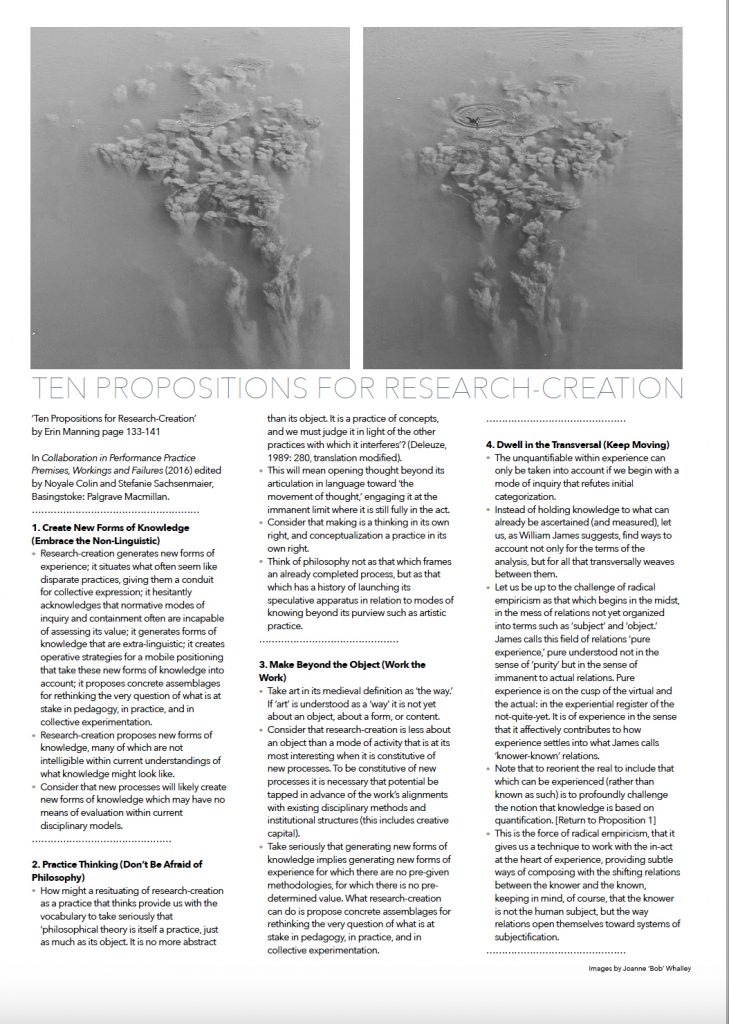
Cite as: Manning, E. (2016). Ten Propositions for Research-Creation. In: Colin, N., Sachsenmaier, S. (eds) Collaboration in Performance Practice. Palgrave Macmillan, London. https://doi.org/10.1057/9781137462466_7
+
The Case for Minor Gestures (2023). Danah Abdulla & Pedro J. S. Vieira de Oliveira DOI: 10.7764/disena.22.Article.6
This paper lays out the groundwork for a concept we define as minor gestures within design education. Moving away from a conversation centered around decolonization—a term, we argue, that has been co-opted to become a placeholder for equality, diversity, and inclusion, and tick-box exercises within academic institutions— we assert that minor gestures create the conditions for meaningful conversations on what it actually means to move towards decolonizing design education. Using examples from our own pedagogical practices, we sketch out and outline a proposition for minor gestures as theory-in-the-making, or an incomplete pathway towards meaningful, structural change (Abdulla & Viera de Oliveira, 2023:2).
License CC BY-SA 4.
Cite as: Abdulla, D., & Vieira de Oliveira, P. J. S. (2023). The Case for Minor Gestures. Diseña, (22), Article.6. https://doi.org/10.7764/disena.22.Article.6
The Undercommons: Fugitive Planning & Black Study. (2013). Stefano Harney and Fred Moten
https://www.minorcompositions.info/wp-content/uploads/2013/04/undercommons-web.pdf
According to Jack Halberstam in Chapter 0 of The Undercommons: Fugitive Planning and Black Study: “If you want to know what the undercommons wants, what Moten and Harney want, what black people, indigenous peoples, queers and poor people want, what we (the “we” who cohabit in the space of the undercommons) want, it is this – we cannot be satisfied with the recognition and acknowledgement generated by the very system that denies a) that anything was ever broken and b) that we deserved to be the broken part; so we refuse to ask for recognition and instead we want to take apart, dismantle, tear down the structure that, right now, limits our ability to find each other, to see beyond it and to access the places that we know lie outside its walls”
Cite as: Harney, S. & Moten, M. (2013). The Undercommons: Fugitive Planning & Black Study. Minor Compositions
+
Qualitative Inquiry in the Making: A Minor Pedagogy (2020) Lisa A. Mazzei & Laura E. Smithers.
These pedagogical events are at once quotidian and more than one. In this spacetime individuation falls away, and the production of qualitative research expertise becomes a function of the entanglement of human and more-than-human pedagogues (Mazzei & Smithers, 2020:1)
Cite as: Mazzei, L. A., & Smithers, L. E. (2020). Qualitative Inquiry in the Making: A Minor Pedagogy. Qualitative Inquiry, 26(1), 99-108. https://doi.org/10.1177/1077800419869966
Minor pedagogy: Education as continuous variation (2024) Lisa A. Mazzei & Laura E. Smithers.
Given that racialized neoliberal efficiency and accountability movements have perpetuated injustice across generations, the work of educational practice that contests this must be practice that slips from these major grips to produce new, more just, worlds. Minor pedagogy produces educational justice through everyday shifts in the conditions of our collective possibility, shifts that manifest difference in ways that reject re-form in the pursuit of the not yet (Mazzei & Smithers, 2024:1)
Cite as: Smithers, L. E., & Mazzei, L. A. (2024). Minor pedagogy: Education as continuous variation. Educational Philosophy and Theory, 56(10), 978–987. https://doi.org/10.1080/00131857.2024.2336021
+
Kafka: Toward a Minor Literature Gilles Deleuze & Felix Guattari (1975 / 1985)
How can we enter into Kafka’s work? This work is a rhizome, a burrow. The castle has multiple entrances whose rules of usage and whose locations aren’t very well known. The hotel in Amerika has innumerable main doors and side doors that innumerable guards watch over; it even has entrances and exits without doors. Yet it might seem that the burrow in the story of that name has only one entrance; the most the animal can do is dream of a second entrance that would serve only for surveillance. But this is a trap arranged by the animal and by Kafka himself; the whole description of the burrow functions to trick the enemy. We will enter, then, by any point whatsoever; none matters more than another, and no entrance is more privileged even if it seems an impasse, a tight passage, a siphon. We will be trying only to discover what other points our entrance connects to, what crossroads and galleries one passes through to link two points, what the map of the rhizome is and how the map is modifed if one enters by another point. Only the principle of multiple entrances prevents the introduction of the enemy, the Signifier and those attempts to interpret a work that is actually only open to experimentation (Deleuze & Guattari, 1985:3).
Cite as: Deleuze, G., Guattari, F., & Maclean, M. (1985). Kafka: Toward a Minor Literature: The Components of Expression. New Literary History, 16(3), 591–608. https://doi.org/10.2307/468842
+
Post Qualitative Inquiry Elizabeth Adams St.Pierre (2014).
Post qualitative inquiry offers a critique of conventional humanist qualitative methodology and marks a turn toward poststructural and posthuman inquiry. It also takes account of the new empiricisms emerging with the ontological and material turns in the humanities and social sciences. This inquiry is not methods-driven but informed by concepts like Karen Barad’s entanglement and Gilles Deleuze and Felix Guattari’s assemblage and by conceptual practices those concepts make possible, practices that will be different in different projects. Post qualitative inquiry is an invitation to think and do educational inquiry outside normalized structures of humanist epistemology, ontology, and methodology (St. Pierre, 2014:1).
https://www.aare.edu.au/assets/documents/Elizabeth-Adams-St.-Pierre-ppt-presentationv1.pdf
+
Becoming-Learner: Coordinates for Mapping the Space and Subject of Nomadic Pedagogy (2013). Rachel Fendler.
How can the process of “becoming learner” be observed, documented, and shared? What methodology could be used to discuss nomadic qualities of learning mobilities? This article argues in favor of an arts-based research approach, specifically social cartography, as a tool that can encourage young people to reflect on their identity as learners. Attentive to the deterritorializations, transgressions, and disruptions that characterize the learning process, it develops a mobile strategy for following the learner. This argument engages the philosophy of Gilles Deleuze and Félix Guattari to explore a pedagogical framework that expands our social imaginary of learning (Fendler, 2013:1).
Cite as: Fendler, R. (2013). Becoming-Learner: Coordinates for Mapping the Space and Subject of Nomadic Pedagogy. Qualitative Inquiry, 19(10), 786-793. https://doi.org/10.1177/1077800413503797
Rachel’s PhD thesis, Navigating the eventful space of learning: Mobilities, nomadism and other tactical maneuvers, can be read here: https://www.tdx.cat/bitstream/handle/10803/318368/FENDLER_RACHEL_PhD_THESIS.pdf?sequence=5.txt
This dissertation addresses a blindness in the field of education that renders some learning practices in visible. By problematizing how learning is both thought and reported on, this study attempts to engage with those pedagogical experiences that fall outside the realm of assessment (Fendler, 2015:i)
+
Review of The Minor Gesture (2017) by Eugene W Holland
If in shorthand we can say that the minor is what varies and the major is what is fixed by social norms and standards, Manning is interested in minor gestures for the ways they introduce variation into experience that would otherwise remain fixed or captured by norms (Holland. 2017:1)
Cite as: Holland, E. W. (2017). The minor gesture. Contemporary Political Theory. Springer Nature
+
https://journalofimaginaryresearch.home.blog/tag/call-for-papers
Call for Abstracts – Journal Of Imaginary Research Volume 12 The Journal of Imaginary Research is now accepting submissions of new short fictional pieces for our annual volume. We publish imaginary research abstracts, and all our volumes are available as free downloads.
Deadline 5pm on Friday 4th December, 2026
What do we mean imaginary research abstracts?
We mean short works of fiction, that take a format that is familiar to us as researchers, academics and the consumers and users of research outputs. An abstract is the summary of an academic paper, that gives us a succinct overview of the research that has been done, and the new outcomes or ideas that the research has generated.
The 2026 theme: Exposure

To be exposed is to be out in the open: unsheltered, undefended and left to the weather. Exposure is the moment the cover comes off and lets in the light. It could mean your skin bared to the sun, a lethal dose of radiation, or a glimpse of something vital: the godhead, truth, the decisive moment.
It is the climbers’ word for the drop beneath your feet. It’s what it’s like to be examined at a viva.
Indeed, researchers live between these senses. Publicity promises exposure as a wage – a practice, as anyone who has worked in a gig economy will note, that doesn’t pay the bills. Peer review is exposure by another name (though Reviewer 2 accepts no exposure of their own). If you have ever suffered from imposter syndrome (and who hasn’t?), you recognise the fear of being exposed as not good enough.
Therapists prescribe exposure in graded doses, on the theory that fear can be slowly eroded, diminished, shrunk.
The word itself arrived around 1600 with ‘composure’ and ‘enclosure’ for company. Shakespeare records it first, in Troilus and Cressida; Macbeth gives it to our ‘naked frailties… that suffer in exposure’. As ever, interpret the theme however you wish – there is no need to explain, and the theme is a mood, a way into the imagination, not a test.
TOP TIP! Indecent exposure has been an offence since 1770; we’d like submissions to retain their modesty whenever possible.
Remember too, that the biography of the imaginary researcher that accompanies your fictional abstract is a good way of introducing links, expansions, satire, commentary and drama into your work. What sort of researcher might produce the imaginary research you describe? Is there a counterpoint in their biography, or something that affirms the work they are doing? How can you use the biography to enhance the fictional aspect of your work. This is your opportunity to indulge in both characterisation and worldbuilding.
TOP TIP! The rarer exposures – southern, insurance, mountaineering, double – may serve you better this year. Cats, dogs and robots as researchers remain heavily oversubscribed as concepts, and are less likely to be selected.
Keep reading to find out how to get started and how to submit your writing…

How to submit
Every entry in this journal is a double exposure: a real writer and an imagined researcher in the same frame.
Download this submission template, follow the instructions, and email it, completed, to kay.guccione@glasgow.ac.uk by Friday 4th December 2026
Our editorial process
Fast and simple. We read everything and do one of three things: (1) accept and publish your piece as it is; (2) make minor edits and publish it in this volume; or (3) return it with suggestions for resubmitting to a future volume. Minor edits may appear without your seeing them first. Copyright of your piece stays with you, and we make no money from the sale of your writing.
We commonly return submissions unpublished when they are not discernibly in the Abstract genre; when typographical errors make them hard to follow; when they contain discrimination, hate speech or derogatory language; when the crude or toilet humour piles too high; or when they run too close to another submission in the same volume.
TOP TIP! Don’t send your completed piece straight away. Give it a day, read it aloud, then submit.

Why do we publish fictional research?
We publish imagined research abstracts as works of fiction firstly because writing for enjoyment is a good thing to encourage. We spend a lot of time trying to reduce our anxiety about writing, and so writing imaginatively is a good way to reshape our relationship with writing into something creative and enjoyable.
Secondly, writing fiction in a familiar format, helps us to reflect on how we can creatively communicate our other research projects, and how we can find the joy of creativity within the grind of productivity. Creativity is a property of all writers and the privilege of all researchers. It allows us to dream and hope.
Can I see examples?
The imaginary abstracts we have published in Volumes 1–11 and our summer 2020 Special Issue were written by real academic staff, research staff, and research students. These volumes of our Journal-zine provide plenty of examples of the different approaches and styles, some funny, some serious, all completely made up.
Enjoy it!
A key aim of our journal-zine is to encourage academic colleagues to embrace writing simply for enjoyment, as an act of care, or as a reflective act. We also hope that reading and writing our imagined works, will bring an enjoyable diversion into your work lives.
Editors: Kay Guccione (on LinkedIn), and Matthew CheesemanPosted in Call for PiecesTagged academic-writing, call-for-papers, news, research, writing